The Plastic Recycling Workshop
  • Home
  • About
  • Updates
  • Contact

updates

DISCLAIMER: The opinions expressed in this website are just that- opinions- and are not to be considered best practices or instruction of any sort. Plastic recycling is hazardous. Risks include cuts, burns, and especially lung damage from toxic fumes resulting from heating plastic of unknown origin. Further, we are not experts. This website is intended to share our experience only- proceed at your own risk.
simple molds

10/18/2023

0 Comments

 
PictureThese are 2D "sandwich" type molds. They were designed in-house and cut for us by an on line metal fabrication service.
One of the issues that we have at the TybeeCleanBeach recycling workshop is the issue of what to make. Our machines are comparatively small, low-volume, low pressure affairs. This means the items that we make are going to be fairly simple.

We also want to break the mindset that plastic is a "use one time, throw away" material. The landfills are full, and burning it isn't very environmentally conscious. Plastic has a long lifespan, and we want to make things that will last and be used for a long time as well... making more plastic spoons is not our mission.

So what we started with were a few of the Precious Plastic designs for sea animal outlines, a coaster, and a square flower pot. Since then, we've expanded to include letters and numbers, and most recently, soap dishes, round flower pots, and small beads for craft projects.

This brings us to the problem of molds. Right now, we use two primary types of molds- stacked molds and true 3D molds.

The "sandwich" type of molds are the simplest. Described in simple terms, these consist of a top plate with some form of injection point, a bottom plate which is usually solid, and a middle plate containing some form of outline. The results of this type of mold- with exceptions- is basically a 2D shape of a consistent thickness, with some kind of outline. For example, our manatee mold is a 2D outline of a manatee. We make these into necklaces, keychains, and fridge magnets.

The exception is our coaster mold, for example. These have a dedicated bottom plate with a shallow, solid circle welded on. This becomes a depression where your glass goes. On the other side, we have a thin laser-cut plate with "Made from recovered plastic, TybeeCleanBeach.org", and then the top plate. 

These sandwich molds are comparatively inexpensive to make- we use both a local waterjet company and an online service to do our cutting for us. I have a diode laser engraver that I use to proof the designs. While I suppose that it would be possible to design molds without this step, it greatly improves my confidence level when I can hold up a cardboard mockup of a mold before we commit the dollars to have it cut from metal.

The other type of mold is a true 3D mold. These are much more complex to design, and expensive to execute. We have a few that we got from Sustainable Design Studio, and they are beautifully made and make an excellent product. When we one day get a grant for a gazillion dollars, we'll have them design and make all our molds... they really know what they're doing.

Even so, these molds are nothing compared to the high-pressure molds used by the plastics industry. It's not uncommon for a professionally made mold to cost ten to twenty thousand dollars. As Sir Alec Guiness said in Star Wars, "These aren't the molds you're looking for." Or something like that, it was a long time ago.

So molds are a big part of any plastic recycling workshop. We spend a great deal of time thinking about molds. Often it's the determining factor when we decide on a new product- where will we get the molds?

​We'll talk about them in more detail in upcoming posts

​

Picture
A 3D soap dish mold, provided by Sustainable Design Studios. These are much more complex and expensive, but they work really well.
0 Comments

Injection mini update

10/18/2023

0 Comments

 
We had a bit of a learning curve with our Injection Mini machine from Sustainable Design Studios. We first tried using #2 plastic lids, as this machine's barrel is designed to accept small lids without any shredding. We had a difficult time with these. Many lids are too large to fit directly into the barrel... not a problem though, as I have a bench shear at my house and can easily chop lids in half. The bigger problem is unidentified plastic types. Only about 20% of the lids that we have collected have the chasing arrows recycling symbol on them, so many of the lids we have can't be used without some risk of mixing plastic.

Initially, this is exactly what happened- we somehow got some mystery plastic mixed in with our #2, and none of the molds we tried would fill. At first we thought it was because our temperature was set too low, but we finally attempted to operate the machine without a mold attached. The cause of the problem became immediately apparent when a small blob of plastic would come through, and then clog. Increasing the temperature finally allowed us to clear the barrel.

That's when we made the decision to switch to shredded #5 plastic, as we are a lot more familiar with this type- we've been using #5 exclusively on our larger machine for a year and a half. But we were still having problems getting the molds to fill.

With some more experimentation, though, we have found a workflow that gives pretty consistent results. First, molds on this machine have to be pre-heated. Fortunately we had a large toaster oven that we could use. About 20 minutes at  around 250 degrees brings the mold up to a working temperature. Working with a hot mold is more difficult, as you have to protect your hands with thick gloves, but one gets used to this fairly quickly.

Another problem that we had was leaks at the nozzle. This was caused by a spacer block that was a bit too low... an easy fix using some of the wood spacers that are supplied with the machine. You have to take care when placing the mold to position the injection point at the correct spot, and this takes care of most leaks. The nozzle can get a little grubby after a few injections, so an occasional wipe to clear any larger hardened blobs helps.

We are also finding that we have to run our machine pretty hot at about 245 degrees. This does result in a little smoke, especially when you add plastic to an empty barrel. Any smoke is generally bad, but we are finding that a small amount is somewhat necessary. Both our machines are fairly low-pressure affairs, so having hotter, more liquid plastic is an advantage. But- and this is important- I'm merely describing events in our shop. I'm NOT GIVING INSTRUCTIONS HERE! Always work with adequate ventilation, and never breathe any smoke, fumes or vapors given off by melting plastic... proceed at your own risk!

The last little detail in our workflow is a shot of WD40 or silicone lubricant on our mold surface before injection. This probably has a minimal effect, but I figured that it wouldn't hurt.

The end result of all this is in the photo below. I was able to produce ten useable flower pots out of ten tries. Total time, one person, appx 2 1/2 hours. We are using an eight minute timer that we start when we fill the barrel. I estimate that removing the mold from the oven, placing it correctly in the machine, injecting, and reloading the barrel takes about 2-4 minutes. This gives an approximate production time of about 10-12 minutes to produce a single four-inch flower pot.


Picture
Picture
They're supposed to look like this. A completed pot before trimming.
Picture
One of our first attempts at a flower pot. We produced a fair number of these before we had any success.
Picture
This is the result of about 2 1/2 hours of work... ten flower pots. No one said recycling your own plastic is fast.
0 Comments

key machines #2a- the injection mini

9/26/2023

0 Comments

 
Picture
We have a very new addition to our workspace. A few months ago, we decided to purchase the Sustainable Design Studios Injection Mini machine. As of this writing (Sept '23), it's literally brand new to us... I've only run one shot of plastic through it, and we are still trying to dial in the settings and establish a workflow. This post will be more about our decision to purchase an additional machine, and the setup process.

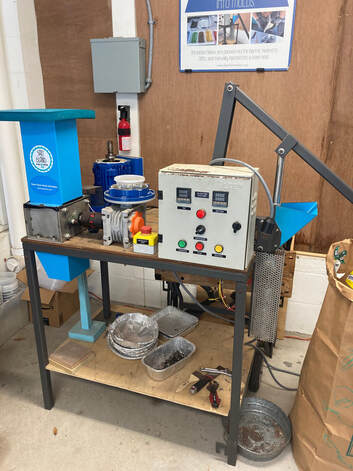
There are a couple of reasons why we wanted a second injection machine. One is size. Our primary Precious Plastic injection machine is mounted on a table with a precious plastic shredder, and as a result it's really heavy. Moving it around is a production, so it lives in our shop. It also requires 220 volt power. These two facts make doing demonstrations with this machine very impractical.

Another reason for this machine is that it can be operated by one person, rather than two. Injection force is supplied by an air cylinder instead of manually, so pressure can be controlled very uniformly from shot to shot. It also allows for something called "hold time," where you keep the pressure on the molten plastic after it fills the mold. This reduces defects caused by shrinkage.

A third reason was to try out a different nozzle design. The Injection Mini has an unthreaded tapered nozzle rather than a threaded type, allowing the molds to be simply pressed against the injector, rather than having to be screwed on. This is something that I've wanted to try on our larger machine.

We ordered our machine assembled, rather than as a kit. If we were to do it again, we would get the kit. While it doesn't save you much in terms of the cost, it's nice to have an assembled machine ready to go- or so we thought. 

Our machine suffered some rough handling during shipping. The frame wasn't bent, but there were several places where it had shifted by maybe 2-3mm. As a result, the air ram wasn't properly lined up with the heater tube- it was maybe 2-3 degrees out of parallel, and it would hit the edge of the tube rather than entering cleanly down the center. So the entire thing needed to be disassembled, lined up square, and screwed back together.

The frame is made with 8020 aluminum extrusions. This is a great system for building machines, and it's commonly used in industrial applications. But there's a tiny little detail that caused a mountain of frustration. The screws that hold the entire frame together are held with special nuts that slide into the slot on the 8020 rails. 

It turns out that there are two types of these nuts. One type is called a "drop-in" nut, the other is called a "slide-in" nut. A drop-in nut can, in theory, be added to the frame at any point in the construction. You simply place the nut, and then when you tighten the screw it rotates 90 degrees to secure the connection. That's the theory. In practice, the nut can rotate five degrees and catch on an edge, giving the impression that it's secure, but resulting in a very weak connection that's easily loosened with vibration or a jolt... like when something is shipped across the Atlantic ocean. We had multiple points on our machine that were not secured at all. In fact, when we laid our machine down to begin assessing the problems several fasteners just fell out of the machine from unknown places.

The solution greatly slows the assembly process and requires planning, but it prevents these problems. We bought some slide-in nuts, slid them onto the rails before assembly, and located them in their correct position with a small spot of craft glue. Since they cannot rotate, these connections are much more secure. If one of these machines is built from a kit, you should replace ALL of the supplied connections with slide-in nuts, which is possible when you start from scratch. Since our machine was pre-built, I spent a long time locating the nuts in the correct position, rotating them in place, and holding them in place with a small spot of glue. It required great care, because if something wasn't correct and needed to be unscrewed, more often than not the nut rotated out of position and fell out. I swore. A lot.

​But the machine is now corrected and operating nicely. As I said, we haven't developed the proper setting and workflows yet, but it can be operated by one person rather than two, and it's very portable. I believe it will be a useful addition to the shop.


​

0 Comments

key machines #2- the injection machine

9/25/2023

0 Comments

 
Picture
Our second key machine is our Precious Plastic-designed injection machine. This open-source design has been around awhile, and while it's far from perfect, it has made our recycling operation possible.

In theory, a plastic injection machine is pretty simple. Imagine a giant syringe with a heater on it... that's how plastic injection machines work. In practice, it's a little more complicated.

Our injection machine has a long lever arm connected to a steel plunger that fits into a seamless steel tube. The tube has a pair of band heaters around it, along with a pair of thermocouples to monitor the temperature. These are connected to a pair of PID temperature controllers- one for the upper part of the tube, and another for the lower part. The tube has a threaded end for common 1/2-inch pipe fittings. The dies screw on to the threaded tube.

The advantages of this design are that it's relatively simple, so that it's easily repairable if something goes wrong. It also has- comparatively- a very large capacity for this type of machine. Typically, a small benchtop design used by industry will have a capacity of 5-30 cubic centimeters. The Precious Plastic design can inject 150 cubic centimeters. This additional volume is important, since we are making thicker items that are designed for a long lifespan. Conversely, the plastics industry typically produces thin plastics (think water bottle thin) that require very high pressures and very uniform, pure raw materials.

And while overall, this injection machine is a great design, there are a couple of dumb things about it. Foremost is that it take two people to operate- one to screw on the mold and cap the barrel, and a second person to operate the lever arm. Another is that the ergonomics of this machine are terrible- it was obviously designed by young people with great knees and hips. You need to work on your knees in order to screw on the dies, and since you're screwing the dies on essentially upside down, it's very easy to cross the threads and damage either the die or the barrel. The barrel also needs to be capped with a screw plug while the plastic is heating, otherwise it runs out.

Overall, though, the advantages far outweigh the downsides. It's pretty essential to have a certain volume of plastic per shot, and this machine can inject enough for a small flowerpot, two coasters, or multiple stacks of sea animals- these are our primary products, I'll write more about these in a future post. If you are thinking of setting up your own recycling workspace, I believe this design would probably be the best choice, design flaws and all. I've been thinking about ways to improve the design- it's one of those projects that I'll get to as time allows.

0 Comments

key machines #1- the shredder

9/25/2023

0 Comments

 
In our shop, we have three key machines that are pretty much essential for recycling plastic: a shredder, a "large" injection machine, and our new "small" injection machine.
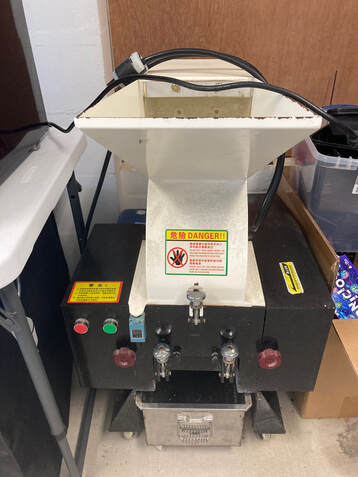
PictureOur commercial shredder. Expensive, but necessary.
First off, the shredder. Some kind of way to cut the plastic into smaller bits is necessary in order to remelt and fit into most machines (with an exception, more on that in a minute). 
Our first shredder was the Precious Plastic design. These resemble an oversized paper shredder driven by a large gear motor. This worked fine for a while, though it did have a tendency to jam every once and a while. But after a few months of pretty regular use,  the large and expensive motor burned out. We aren't sure why this happened, though I suspect it's a 240 volt motor, and we were feeding it 220v or something like that.

Whatever the reason, now we were in trouble. We were collecting a LOT of #5 plastic, and we had to have a shredder in order to keep up with it. We were unable to find a local electrical shop to rebuild the burned-out motor.

So we ordered a small commercial shredder that is used in the plastics industry. It's one of the smaller ones made, but for us, it's a monster. It operates at high speed, and has large, strong cutterheads that can chew up just about anything we can throw into it. Though just to be safe, we usually pre-chop the really big stuff into smaller bits... just in case.

0 Comments
Forward>>

    By bg

    Engineering and maintenance department of TybeeCleanBeach

    Categories

    All

    RSS Feed

Powered by Create your own unique website with customizable templates.
  • Home
  • About
  • Updates
  • Contact
